The Multi-Lakh "Site Visit Leak" Bankrupting Ad Budgets
Consider the true mathematics of real estate marketing in 2026: A developer and their Channel Partners spend ₹5,00,000 to ₹15,00,000 every month on performance ads, cab sponsorships, and presales tele-calling teams.
By the time a buyer steps into your air-conditioned sales gallery, your effective Cost Per Site Visit (CPSV) is between ₹3,000 and ₹7,500.
Yet if your on-site closing ratio is an anemic 3.5%, you require nearly 30 walk-ins just to close one flat. By lifting your closing ratio to 11%, you instantly triple your sales velocity with the exact same marketing expenditure.
Step 1: Harmonizing the Builder & CP Alliance at the Front Gate
The biggest invisible leak in Indian real estate occurs before the customer even sits down with a sales executive: friction between the Channel Partner and the Developer's in-house reception desk.
When a broker feels threatened that the builder's sales manager will hijack their buyer or deny commission credit, the broker will hold back crucial buyer intelligence (such as actual budget limits, family negotiation dynamics, or urgent relocation deadlines).
1. The Digital OTP Gate Verification
Replace messy handwritten register notebooks with a branded iPad reception kiosk. When the CP arrives with the client, the client enters a 4-digit SMS OTP sent to their mobile phone. This locks the CP's RERA tag into the developer's CRM for 30 days. No arguments, no suspicions, and no human tampering.
2. The 3-Minute Pre-Briefing Alignment
While the receptionist serves the client their beverage of choice, the CP and the builder’s closing manager take 180 seconds in the back room to sync: "Client is an IT VP in BKC, budget is strictly ₹2.1 Cr, wife loves morning sunlight, looking for Tower B 14th floor or above."
3. United Negotiation Front
In the discussion cabin, the CP and closing manager work as trusted partners rather than opposing negotiators. The CP reinforces the exclusivity of the inventory, while the developer sales manager demonstrates flexibility on payment milestones.
Step 2: The 5-Zone Psychology of an Experiential Sales Lounge
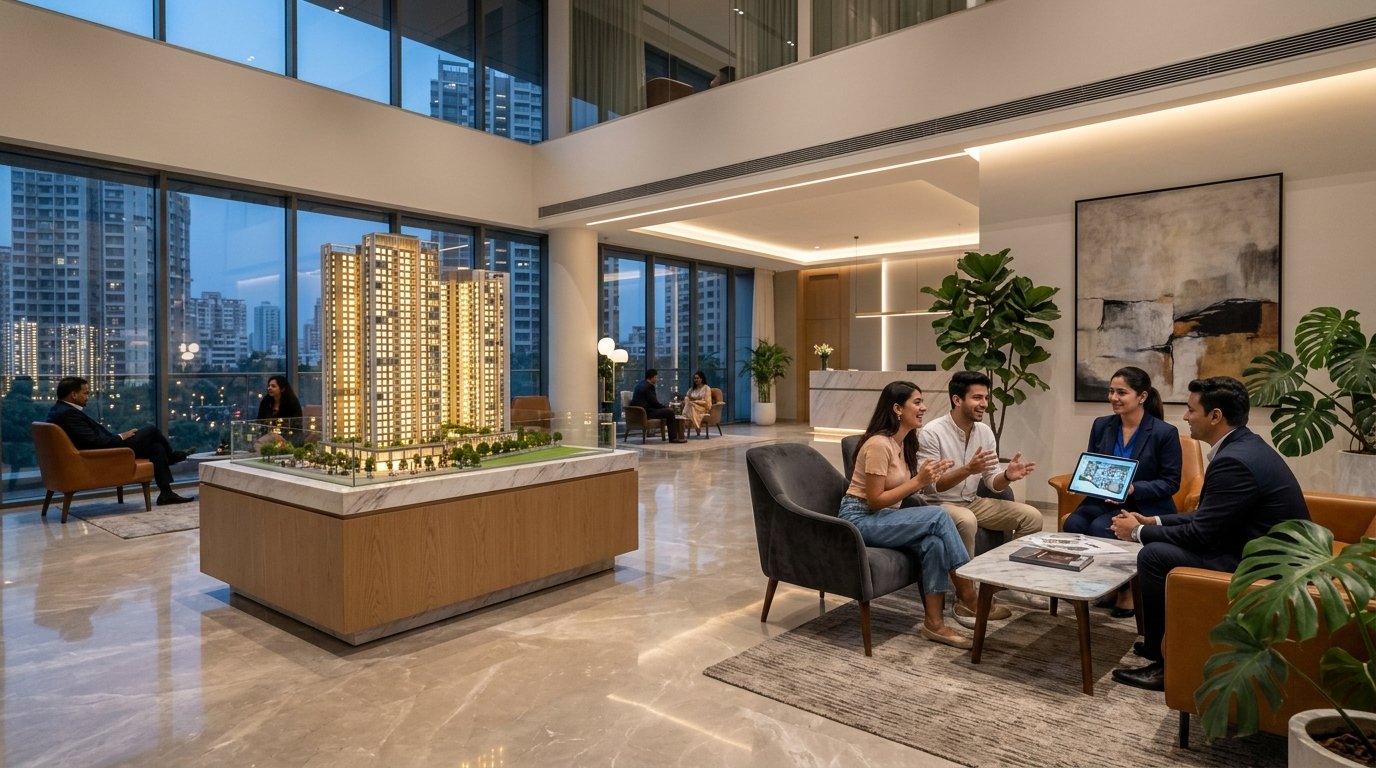
Top-tier developers no longer dump buyers into generic cubicles. The physical customer journey is calibrated into five psychological zones:
Zone 1: The Decompression Lounge
The buyer just drove 45 minutes through Mumbai traffic. Never rush them into blueprints immediately. The first 5 minutes must feature acoustic tranquility, subtle signature fragrances, cold water, and gourmet coffee to lower cortisol levels and build receptivity.
Zone 2: The Infrastructure & Scale Model Arena
Present the micro-market macro narrative before showing apartment layouts. Walk around the illuminated architectural 3D scale model to demonstrate upcoming metro stations, coastal road access, lifestyle retail, and developer track record.
Zone 3: The Sample Flat Experience
Ditch dry square-footage jargon. Present experiential storytelling: "Notice how the master bedroom opens directly onto this 60-foot running deck where you can watch the sunset over the Arabian Sea." Give the client physical touchpoints—let them sit on the living room sofa and visualize living there.
Zone 4: The Closing Cabana & Financial Structuring
Move to a semi-private consultation cabana with natural lighting. Introduce a senior closing manager accompanied by an on-site bank representative who can pre-approve loans in 15 minutes, removing financing doubts on the spot.
Zone 5: The Gong & Celebration Bell
When a customer signs a booking form and pays the initial token, ring the ceremonial brass bell or gong in the sales lounge followed by applause from the entire floor. This creates instant social proof for other visiting families currently hesitating in adjacent cabins.
Indian Real Estate Conversion Benchmarks (2026)
How do your sales gallery closing ratios compare with top-performing developer assets across segments?
| Residential Segment | Ticket Size | Industry Average | Top 5% Performance |
|---|---|---|---|
| Affordable Housing | ₹25L – ₹65L | 6.0% – 8.0% | 14.0% – 18.5% |
| Mid & Upper-Mid Segment | ₹80L – ₹2.5 Cr | 3.5% – 5.5% | 9.5% – 13.0% |
| Luxury & Ultra-Luxury | ₹3.5 Cr – ₹15 Cr+ | 1.5% – 2.8% | 4.5% – 7.2% |
| Plotted Land / Townships | ₹40L – ₹1.8 Cr | 5.0% – 7.0% | 12.0% – 16.0% |
Lower Your Cost-Per-Site-Visit & 3X Sales Gallery Closures
KPM Digital Solutions bridges digital ad clicks with physical on-site closures. From high-intent geo-targeted Google/Meta funnels to automated WhatsApp walk-in reminders and sales lounge closing blueprints, we help developers scale site visits that actually buy.
Step 3: High-Converting Spot Incentives (Without Ruining Price Integrity)
Never offer a desperate flat discount like: "Sir, if you book today, we will reduce ₹200 per square foot." Slashing base rates damages project brand prestige, angers existing buyers, and encourages the prospect to delay further in hopes of deeper price cuts.
Instead, utilize structured Value-Add Urgency Drivers that cost the developer pennies on the rupee:
1. Maintenance & Utility Shields
"24 Months Free Society Maintenance" or "Complimentary Club Membership". High emotional relief for the buyer, yet standard operational accounting for the builder.
2. Stamp Duty & Registration Subvention
Covering 5% or 6% state stamp duty as a limited spot-offer removes the #1 upfront liquidity barrier that causes prospective buyers to postpone payment.
3. Modular Interior Partner Vouchers
Co-branded partnerships with leading interior firms (e.g. Livspace, HomeLane) offering a ₹3.5 Lakh kitchen and wardrobe credit for bookings executed within 48 hours of site visit.
4. Floor-Rise Waiver Tokens
Waiving floor-rise charges up to the 12th floor for spot bookings. The customer feels they won a premium upper-level unit without the developer altering baseline list pricing.
Step 4: The 48-Hour Critical Follow-up Matrix
Over 65% of eventual buyers do not swipe their credit cards on their very first walkthrough—they need to consult family members, check their provident fund balances, or sleep on the decision.
If your sales team waits four days before sending a casual "Hello sir, did you think about the flat?", the deal is dead. High-performing closing desks implement this 48-hour protocol:
Automated WhatsApp message: "Thank you Mr. & Mrs. Sharma for visiting KPM Residences today. Here is the personalized 4K walkthrough video of the exact 3BHK Unit 1402 you toured, alongside your customized cost-sheet."
The Channel Partner makes a cordial phone call to address lingering objections: "Mr. Sharma, the bank has verified your pre-qualification for a 7.9% home loan rate. The builder's sales head has kept Unit 1402 blocked exclusively for you until tomorrow 4:00 PM."
Final decision window: The developer sales director personally extends a VIP invitation for an evening tea at the sales gallery to sign the allotment token with the spot-incentive locked.
Frequently Asked Questions on Site Visit Closings
How can presales teams filter out unqualified walk-ins before they reach the site?
Presales teams must implement the BANT Framework (Budget, Authority, Need, Timeline). If a prospect's declared budget is ₹90 Lakhs and your entry-level apartment begins at ₹1.65 Cr, presales should steer them to a different project rather than scheduling a site visit that will only waste sales gallery bandwidth.
Should developers provide free cab pickups (Uber/Ola) for prospective buyers?
Yes! Offering automated one-click Uber/Ola executive cab rides increases scheduled site visit show-up rates by 35% to 42%. Buyers are less stressed by parking hassles, arrive relaxed, and view the developer as customer-centric before even entering the gate.
What is the ideal duration for a sales gallery walkthrough?
The optimal duration is 45 to 60 minutes. Anything shorter than 30 minutes indicates the prospect wasn't engaged emotionally; anything dragging beyond 90 minutes results in decision fatigue where the client defaults to: "We will think about it and let you know."